








When you consume 7-OH, it binds to your brain’s mu-opioid receptors with nanomolar affinity, triggering pain relief and euphoria through G protein signaling pathways. Your liver’s CYP3A4 enzymes process it slowly, allowing extended effects throughout your system. This partial agonist activates reward circuits while affecting your breathing rate, slowing digestion, and potentially causing constipation. Understanding the complete mechanism behind these receptor interactions reveals why tolerance and dependence develop over time.
What Is 7-OH and Where Does It Come From
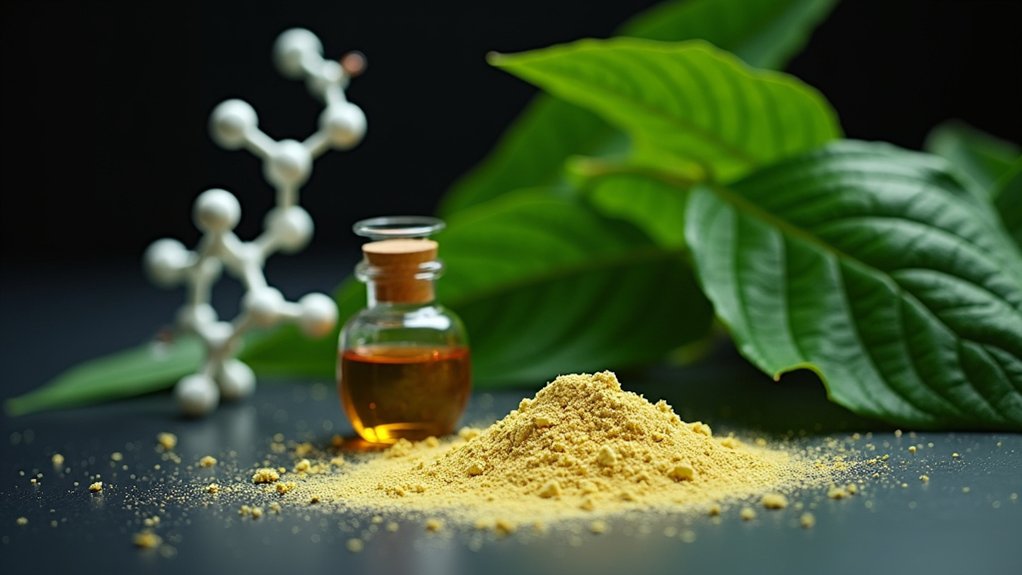
7-Hydroxymitragynine (7-OH-MIT) is a terpenoid indole alkaloid found in the kratom plant (*Mitragyna speciosa*), first described scientifically in 1994. With a chemical formula of C23H30N2O5 and molecular weight of 414.40 amu, this compound functions as a partial mu-opioid receptor agonist in your body.
Despite its potency, 7-OH exists as a minor alkaloid constituent within kratom leaf content, comprising less than 2% of total alkaloids. Natural concentrations range from 0.01-0.04% by weight. Manufacturers now also produce synthetic 7-OH products in high concentrations that are sold separately from natural kratom. Because extracting 7-OH in high concentrations from natural kratom leaves is not practical, these products are typically created semisynthetically via oxidation of mitragynine.
Your liver produces 7-OH endogenously when CYP3A4 enzymes metabolize mitragynine through hepatic oxidation. This conversion process means you generate this potent alkaloid internally after consuming kratom, regardless of the trace amounts present in the original plant material. Once formed, 7-OH binds strongly to the brain’s mu-opioid receptors, producing powerful analgesic and sedative effects that are several times more potent than morphine.
How 7-OH Binds to Opioid Receptors in Your Brain
When you consume kratom, 7-OH binds to your mu-opioid receptors with a Ki value of approximately 37 nM, significantly stronger than mitragynine but weaker than morphine, displacing your brain’s natural endorphins from these receptor sites. This binding occurs because 7-OH’s molecular structure fits precisely into the MOR binding pocket, competing with and outperforming endogenous opioid peptides for receptor occupancy. As a partial agonist with an Emax of approximately 47%, 7-OH activates your mu-opioid receptors to a ceiling effect rather than producing full activation, which shapes both its therapeutic potential and its safety profile. Research has shown that modifying the C11 position of the 7-OH molecule can fine-tune this receptor signaling efficacy, potentially creating even safer opioid therapeutics with reduced adverse effects. The conversion of mitragynine to 7-OH is mediated by cytochrome P450 3A isoforms in the liver, highlighting how your body’s metabolic processes determine the ultimate opioid activity you experience from kratom consumption. Studies demonstrate that 7-OH exhibits high selectivity for MOR over kappa-opioid receptors and delta-opioid receptors, which contributes to its more consistent and predictable opioid effects compared to mitragynine.
MOR Binding Affinity Explained
The mu-opioid receptor (MOR) serves as 7-OH‘s primary molecular target in the brain, and understanding this binding relationship reveals why the compound produces its characteristic effects. 7-OH demonstrates remarkably high MOR binding affinity, with Ki values ranging from 7.2 to 70 nM across various assays, approximately 37 ± 4 nM in standardized measurements.
This affinity vastly exceeds mitragynine’s binding strength at 230 ± 47 nM, explaining why 7-OH drives the parent compound’s analgesic activity. Receptor localization studies across CHO and HEK 293 cell systems consistently confirm this high-affinity interaction.
When 7-OH binds to MOR, it initiates signaling cascades that differ from traditional opioids. The compound functions as a G protein-biased partial agonist, achieving 70% efficacy compared to the DAMGO standard while preferentially activating specific downstream pathways.
Displacing Natural Brain Chemicals
At the molecular level, 7-OH competes directly with your brain’s endogenous opioid peptides, endorphins, enkephalins, and dynorphins, for access to mu-opioid receptor binding sites. This neurotransmitter displacement occurs because 7-OH’s charged amino group forms a salt bridge with Asp147 at the receptor’s orthosteric site, the same critical interaction your natural opioids use.
Your endogenous opioid system typically regulates pain perception, mood, and reward through these peptides. When 7-OH enters your system, it binds preferentially to MOR with nanomolar affinity (13.5-37 nM), effectively outcompeting your naturally produced opioids. Unlike full agonists, 7-OH functions as a partial MOR agonist while antagonizing kappa and delta receptors. This receptor selectivity hierarchy means 7-OH primarily modulates MOR-mediated pathways while blocking KOP and DOP signaling. Importantly, 7-OH preferentially recruits G protein over β-arrestin2, which may explain why kratom alkaloids produce antinociceptive effects with limited side effects compared to traditional opioids.
Partial Agonist Activity Effects
Beyond displacing your natural opioids, 7-OH’s binding behavior determines exactly how much receptor activation occurs, and this partial agonist profile shapes everything from pain relief to side-effect risk. 7-OH binds MOR with nanomolar affinity (Ki ~7, 40 nM), considerably stronger than its affinity for delta (DOR ~90 nM) or kappa receptors (KOR ~130 nM).
This MOR selectivity concentrates 7-OH’s impact on reward pathways while its partial agonism caps maximal receptor activation. Functional assays show 7-OH reaches only 14, 22% of full agonist efficacy under receptor-reserve-limited conditions, similar to buprenorphine. You’ll still experience robust analgesia because pain circuits maintain sufficient receptor reserve, but potential side effect tradeoffs differ from full agonists. The ceiling on intrinsic activity limits how intensely you can activate MOR-mediated responses, theoretically reducing overdose and respiratory depression risk.
The Pain-Relieving Effects of 7-OH on Your Nervous System
When 7-hydroxymitragynine enters your bloodstream, it rapidly crosses the blood, brain barrier and binds to μ-opioid receptors throughout your central nervous system with approximately 13 times the potency of morphine. This binding inhibits ascending pain transmission in your dorsal horn while enhancing descending inhibitory pathways from your brainstem to spinal cord.
| Mechanism | Location | Effect |
|---|---|---|
| μ-receptor activation | Spinal dorsal horn | Blocks nociceptive signaling |
| Neurotransmitter suppression | Primary afferents | Reduces glutamate/substance P release |
| Descending pathway enhancement | Brainstem-spinal cord | Decreases neuronal excitability |
| Pain affect modulation | Limbic system | Alters emotional pain response |
| Reward circuit engagement | Mesolimbic pathway | Produces euphoria alongside analgesia |
Your pain relief occurs through G protein, biased signaling, which may reduce β-arrestin, mediated side effects compared to traditional opioids. Beyond μ-receptor activation, 7-OH also functions as an antagonist at δ- and κ-opioid receptors, which contributes to its unique pharmacological profile and distinguishes it from conventional opioid analgesics. This makes 7-OH one of the most potent naturally-occurring opioid-like compounds known to researchers studying plant-derived analgesics. The compound’s neuroprotective potential is linked to mitragynine’s ability to modulate the Keap1-Nrf2 pathway, which regulates antioxidant gene expression in neuronal tissue.
How Your Liver Processes and Metabolizes 7-OH
Once 7-hydroxymitragynine binds to your μ-opioid receptors and produces analgesia, your liver begins processing this potent alkaloid through specific enzymatic pathways. Unlike its precursor mitragynine, 7-OH demonstrates remarkable stability in hepatic tissue, resisting Phase I oxidative metabolism.
Your liver’s metabolic pathways involved in processing 7-OH show distinct characteristics:
- Over 90% of 7-OH persists after 40 minutes of microsomal incubation
- CYP3A4 enzymes minimally affect 7-OH concentrations
- Extended exposure doesn’t considerably reduce hepatic 7-OH levels
- Human liver microsomes metabolize 7-OH with half-lives exceeding 60 minutes
Species-specific differences markedly impact 7-OH processing. Your human hepatic system metabolizes this compound much slower than rodent or primate models. This resistance to hepatic degradation explains 7-OH’s accumulation and prolonged receptor activity in your system. Research shows that liver metabolism of 7-HMG was much greater than plasma metabolism in rats and monkeys, highlighting key differences between hepatic and blood-based processing.
Effects of 7-OH on Breathing, Digestion, and Other Body Functions
When 7-OH activates your mu-opioid receptors, it triggers dose-dependent respiratory depression with more than three-fold greater potency than morphine, a critical distinction from mitragynine’s ceiling effect. Your breathing slows because 7-OH functions as a full agonist at these receptors, engaging the same suppressive pathways that classical opioids use to depress respiratory drive. Studies indicate that 7-OH has up to 13 times the potency of morphine, making it exceptionally dangerous even in small amounts. Beyond your lungs, mu-opioid activation in your gastrointestinal tract reduces gut motility, potentially causing the constipation and digestive slowing characteristic of opioid receptor stimulation throughout your enteric nervous system. Research using whole body plethysmography in awake, freely moving mice has demonstrated these respiratory effects in controlled experimental settings. Additional side effects from this opioid receptor activation can include nausea, confusion, agitation, and sedation characteristic of opioids.
Respiratory System Impact
Most users don’t realize that 7-OH’s effects on breathing stem directly from its powerful activation of μ-opioid receptors in the brainstem, the same receptors that morphine and fentanyl target. This binding suppresses your respiratory drive, reducing your sensitivity to carbon dioxide buildup in your blood.
Unlike mitragynine, 7-OH doesn’t exhibit a ceiling effect for respiratory depression. Your addiction risk increases with repeated use, while life-threatening consequences escalate with each dose augmentation. As a semi-synthetic derivative of mitragynine, 7-OH demonstrates significantly higher potency than its parent compound, making dosing errors particularly dangerous.
Key respiratory impacts include:
- Decreased respiratory rate and reduced tidal volume leading to hypoventilation
- Dose-dependent suppression without protective ceiling effects
- Rapid progression to apnea in overdose situations
- Synergistic depression when combined with alcohol or benzodiazepines
You’re particularly vulnerable if you’re opioid-naïve, as even moderate doses can profoundly impair respiratory function. These respiratory dangers have contributed to six fatal overdoses now tied to this synthetic substance in LA County alone.
Gut Motility Changes
Why does 7-OH leave you feeling backed up? When 7-OH activates mu opioid receptors in your enteric nervous system, it directly suppresses peristaltic contractions. This receptor-mediated inhibition slows intestinal transit, causing prolonged constipation as a documented side effect.
| Effect | Mechanism | Clinical Result |
|---|---|---|
| Reduced peristalsis | Mu receptor activation | Delayed transit |
| Slowed gastric emptying | ENS suppression | Digestive disturbances |
| Variable absorption | Altered GI motility | Inconsistent bioavailability |
Your gut’s sluggish movement creates a feedback loop affecting 7-OH absorption itself. Since mitragynine converts to 7-OH through hepatic CYP3A4 metabolism, delayed gastric emptying produces erratic plasma concentrations. You’ll experience unpredictable effects because each dose absorbs differently, making therapeutic outcomes unreliable and side effect profiles variable.
Tolerance, Dependence, and Long-Term Impacts on Your System

Anyone who uses 7-OH repeatedly should understand how tolerance and dependence develop at the receptor level. Your mu-opioid receptors undergo neuroadaptation with continued exposure, requiring higher doses to achieve the same effects. This downregulation creates physical dependence that manifests through withdrawal when you stop using.
Long-term impacts include:
- Physical dependence producing withdrawal symptoms like restlessness, body aches, and cold sweats
- Addiction development through receptor-mediated reward pathway activation
- Neuropsychiatric effects including anxiety, depression, and insomnia
- Skin changes such as itching and darkening patches
The long term health impacts extend beyond dependence. Your system becomes increasingly reliant on exogenous opioid stimulation. Addiction cessation typically requires medical intervention because your receptors need time to restore normal function and sensitivity.
Frequently Asked Questions
Can 7-Oh Interact Dangerously With Other Medications or Supplements I’m Taking?
Yes, 7-OH can interact dangerously with your medications. Its potential interactions with prescription drugs stem from CYP2D6 and CYP3A4 enzyme inhibition, affecting over 50% of medications you might take. Quetiapine metabolism slows considerably, while modafinil combinations increase seizure risk. Possible side effects with alcohol consumption include severe respiratory depression through additive CNS depressant effects. Serotonergic medications and sedatives pose particularly serious risks when combined with 7-OH’s mu-opioid receptor activity.
How Long Does 7-Oh Stay Detectable in Drug Tests?
Your metabolite detection duration depends on the testing method used. Standard drug panels won’t detect 7-OH since they don’t screen for kratom alkaloids. However, specialized tests can identify it. The urine screening timeframe extends up to 7-9 days post-ingestion, while blood tests only catch it within 24 hours. Saliva offers the shortest window at 24-48 hours. Advanced methods like LC-MS/MS provide the most accurate detection for receptor-specific kratom metabolites.
Is 7-Oh Legal in My State or Country?
You’ll need to check your specific state’s regulations since 7-OH’s legal status varies considerably. Currently, Alabama, Arkansas, Indiana, Rhode Island, Vermont, Wisconsin, and Florida classify 7-OH as a controlled substance. California prohibits it in foods and supplements. Legality concerns surrounding 7-OH continue expanding as eighteen states now regulate it. The availability of 7-OH in local markets depends entirely on your jurisdiction’s current enforcement actions and scheduling decisions.
What Makes Concentrated 7-Oh Products Riskier Than Traditional Kratom Leaves?
Concentrated 7-OH products deliver considerably higher potency at your opioid receptors, up to 13 times stronger than morphine, compared to natural kratom leaves. You’re facing a lack of standardization across unregulated products, meaning you can’t predict the actual 7-OH concentration you’re consuming. Additionally, potential contamination with heavy metals or pathogens increases your risk. This unpredictable receptor activation dramatically raises your chances of respiratory depression and overdose compared to traditional leaf consumption.
Are There Any Known Antidotes if Someone Overdoses on 7-Oh?
Since 7-OH acts as a μ-opioid receptor agonist, naloxone (Narcan) may reverse its effects by competitively blocking these receptors. However, you should know that naloxone’s effectiveness against 7-OH hasn’t been extensively studied in clinical settings. If you suspect an overdose, call emergency services immediately and seek immediate medical attention. Medical professionals can administer naloxone and provide respiratory support while monitoring your cardiovascular and neurological status.